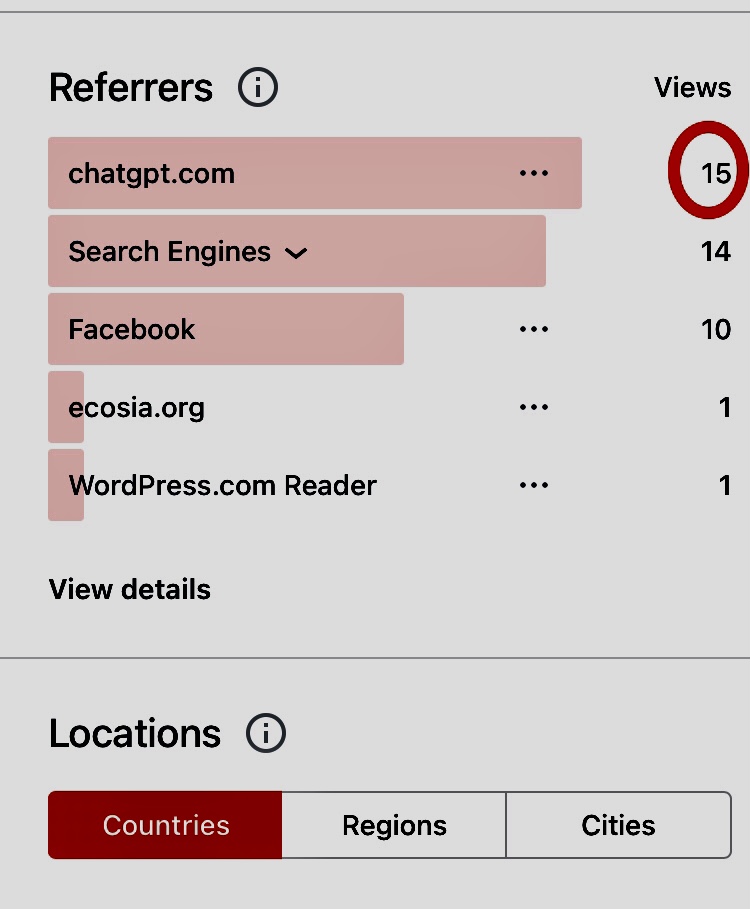
I have recently noticed, that my blog’s visibility has improved thanks to ChatGPT as a new source of organic traffic. I have also watched a very interesting webinar about the innovative approach to SEO. What is it?
Instead of being VISIBLE in a traditional, well-known way of defining discoverability (SEO, keywords etc.) become a PART OF THE CONVERSATION. Wait, what?
Do these two joined together ring a bell yet?
I asked GPT about it and it was keen to share some useful tips – who knows better what GPT needs to receive in order to expose your site to more users, than the GPT itself? 🙂
To make sure your company or website is surfaced in ChatGPT or AI tools like it when users ask questions, you need to optimize your online presence for AI visibility, not just search engines like Google.
Here’s a some aspects of how to do that effectively when you run a blog or online business:
AI Indexing & Mentions
- Popular SEO discussions highlight that ChatGPT primarily sources information via Bing’s index, sometimes returning webpages as citations
What That Means for You
- You can ask chatGPT about your presence or absence in AI- cited content
- Absence from AI-cited content would suggest your site is not currently prioritized or picked up by AI systems like ChatGPT
- This doesn’t necessarily reflect on quality—it may be due to lower Bing search rankings or weaker signals like backlinks, schema markup, or brand mentions
Strategies to Improve AI Visibility
Here’s how to raise your AI presence, using practices known to work:
| Strategy | Why It Helps |
|---|---|
| Optimize for Bing | ChatGPT draws from Bing; ranking high there boosts chances |
| Add structured schema + FAQs | Pages using FAQ markup get picked up fast—some saw inclusion within days |
| Target high-intent, niche queries | Specific long-tail keywords perform better for AI visibility |
| Earn contextual links | Links from thematic sites (e.g. niche blogs, forums) signal relevance to Bing/HITL reviewers |
| Build brand mentions off-site | Mentions across blogs, podcasts, social proof reinforce brand association for AI |
| Monitor ChatGPT referrals | Use analytics tools or server logs to track referrers that originate from AI-based search |
For an average blogger the interesting part doable with low time and effort investment could be the FAQ section. Whenever you go to Google to ask a question, you will see a list of examples of questions with answers, that have the power to drive traffic to your website.
What is FAQ schema and long-tail keywords?
Great question! Let’s break down both FAQ schema and long-tail keywords in a way that’s practical for your blog or website:
What is FAQ Schema?
FAQ schema is a type of structured data (written in JSON-LD) that you add to your webpage to tell search engines (like Google and Bing) that your content contains questions and answers.
Why it matters:
- Helps search engines understand your content better.
- Can trigger rich results in search (like expandable FAQs under your link).
- Boosts your chances of being referenced by AI tools like ChatGPT or Bing Chat.
Example of FAQ schema (JSON-LD):
jsonCopyEdit<script type="application/ld+json">
{
  "@context": "https://schema.org",
  "@type": "FAQPage",
  "mainEntity": [{
    "@type": "Question",
    "name": "What is affiliate marketing?",
    "acceptedAnswer": {
      "@type": "Answer",
      "text": "Affiliate marketing is a way to earn money by promoting other people's products and earning a commission on sales."
    }
  }, {
    "@type": "Question",
    "name": "Can beginners start affiliate marketing for free?",
    "acceptedAnswer": {
      "@type": "Answer",
      "text": "Yes, many affiliate programs are free to join, and you can promote products using free tools like blogs or social media."
    }
  }]
}
</script>
Note for WordPress users: tools like Yoast SEO, RankMath, or Schema Pro can generate this for you in WordPress automatically.
What Are Long-Tail Keywords?
Long-tail keywords are longer, more specific search phrases that usually have lower competition and higher conversion potential.
✨ Examples:
| Short Keyword | Long-Tail Version |
|---|---|
| affiliate marketing | how to start affiliate marketing for beginners in 2025 |
| digital products | best digital products to sell on Etsy for passive income |
| AI blogging | how to use ChatGPT to write blog posts fast |
Why they matter:
- Easier to rank for (lower SEO competition)
- Match what real users actually type into search or ChatGPT
- Often lead to more targeted traffic—these users are closer to taking action (buy, subscribe, download)
How to Use Both on Your Blog
Let’s say you’re writing a post titled:
“How to Make Passive Income with Affiliate Marketing”
You could:
- Include a FAQ section at the bottom:
- What tools do I need to start affiliate marketing?
- Can I do affiliate marketing without a website?
- Optimize for a long-tail keyword like: “how to start affiliate marketing without a website in 2025”
Then:
Use it naturally in subheadings and image alt text.
Add that phrase in your headline, meta description, and content.
Bonus: What NOT to Do
- Don’t stuff keywords or over-optimize.
- Don’t publish generic AI-generated posts without editing or adding original insight.
- Don’t try to manipulate visibility with black-hat SEO tactics—AI models are trained to ignore spammy content.

FAQ:
Q1: Why optimize for AI visibility, not just search engines?
- AI tools like ChatGPT often use Bing’s index, so SEO efforts must include AI visibility techniques In The Loop
Q2: What strategies improve AI visibility?
- Rank higher with Bing
- Use structured FAQ schema (e.g., JSON-LD markup)
- Target long-tail niche queries
- Acquire contextual backlinks and brand mentions
- Monitor AI-origin traffic referrers In The Loop
Q3: What are FAQ schema and long-tail keywords?
- FAQ schema: Structured markup that helps search engines understand content and show rich results In The Loop
- Long-tail keywords: Specific, lower-competition search phrases that attract targeted traffic and perform well in AI-driven searches In The Loop
Discover more from In The Loop
Subscribe to get the latest posts sent to your email.

One thought on “Leverage AI to help build your blog’s visibility in this unusual way”